Boyfriend Unamused When His Girlfriend Cites The Death Of A Celebrity As Her Latest Excuse For Her Unemployment
For two and a half years, their love weathered the storms of life, until the pandemic cast a long shadow over their once harmonious world. In the relentless grind of a demanding healthcare career, he found purpose and fortune, but at the cost of endless hours and emotional distance, while Julie bore the silent weight of managing their home and her own restless days.
As he fought exhaustion and seized every overtime paycheck to build their future, Julie’s unexpected resignation marked a turning point—a quiet unraveling filled with isolation, binge-watching, and growing disconnection. Their bond, once strong and steady, now teetered on the edge of fading into the very loneliness they sought to escape together.

















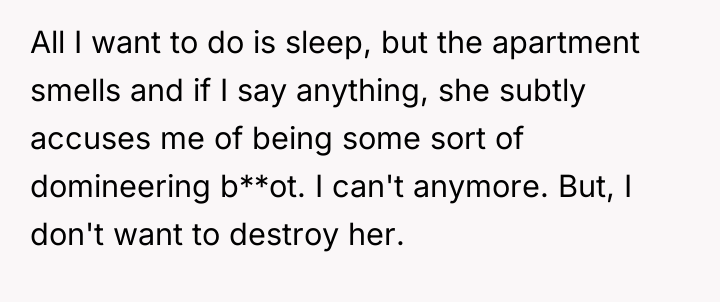
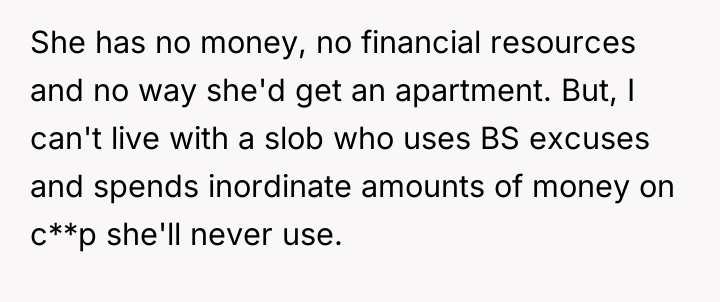
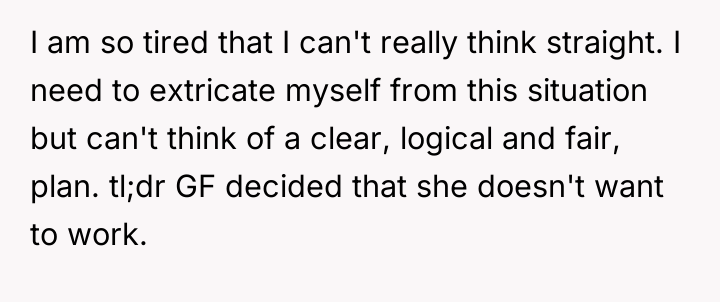


As noted by psychologist Dr. Harriet Lerner, author of 'The Dance of Anger,' dysfunctional relationship patterns often involve one person over-functioning and the other under-functioning. In this case, the OP is over-functioning by managing all finances and housework, while the girlfriend is under-functioning, relying on external excuses (social issues, celebrity news) to avoid accountability for her employment and domestic contributions.
The girlfriend's behavior suggests a pattern of avoidance and potential emotional regulation issues, using constant distraction (binge-watching, impulse buying like night vision binoculars for city 'hiking') to cope with the anxiety of re-entering the workforce or facing domestic duties. The OP’s attempts to address this are met with emotional deflection and accusations of bigotry, a common tactic used to shut down constructive criticism and maintain the status quo where the burden remains entirely on the partner.
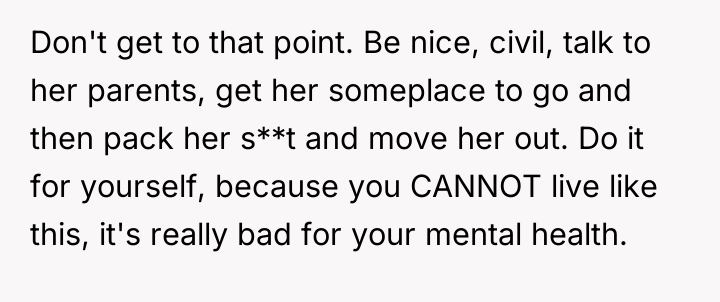
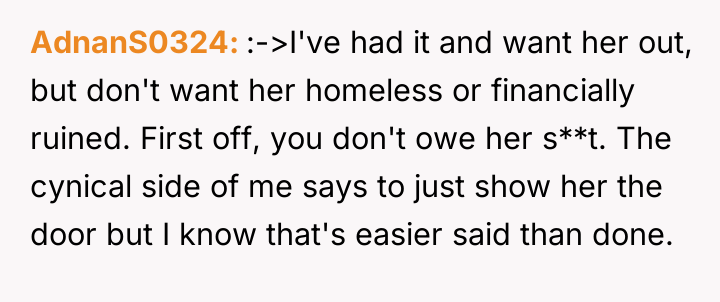
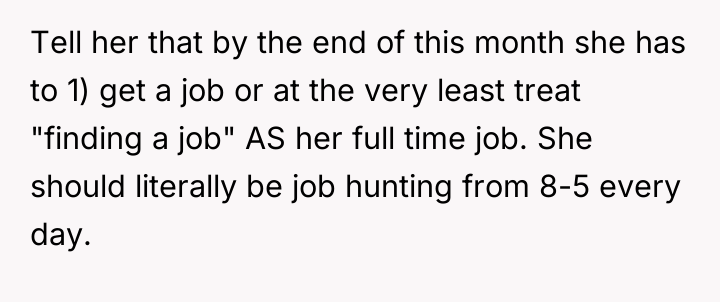
The OP's actions of performing all the domestic labor (laundry, dishes) while also working excessive overtime reinforce the unhealthy dynamic. While the OP is correct to seek separation from this unsustainable situation, threatening immediate departure without a plan risks fulfilling his fear of ruining her financially. A constructive recommendation would be for the OP to communicate a clear, non-negotiable timeline for shared responsibility (e.g., 'By X date, you must apply for Y jobs or contribute Z amount to the household'). If these conditions are not met, the OP must follow through with a less drastic, but firm, separation—such as establishing separate finances and explicitly defining the end date of shared living, perhaps offering temporary, limited financial support contingent on clear steps toward independence.
REDDIT USERS WERE STUNNED – YOU WON’T BELIEVE SOME OF THESE REACTIONS.:
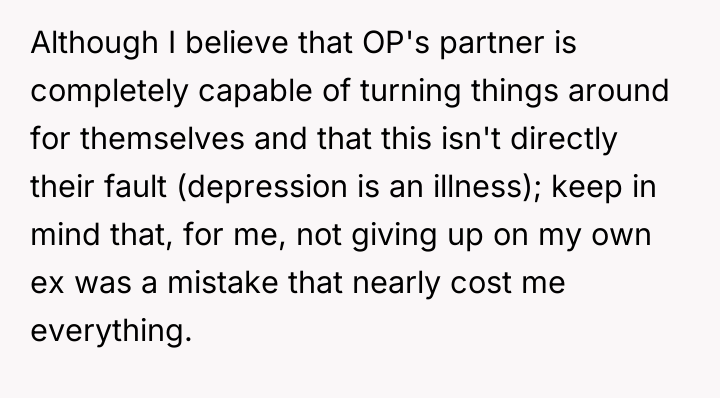
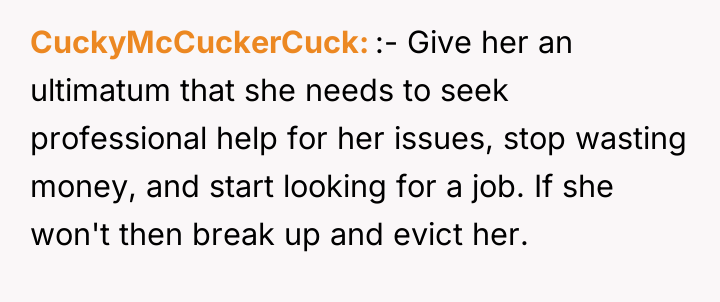
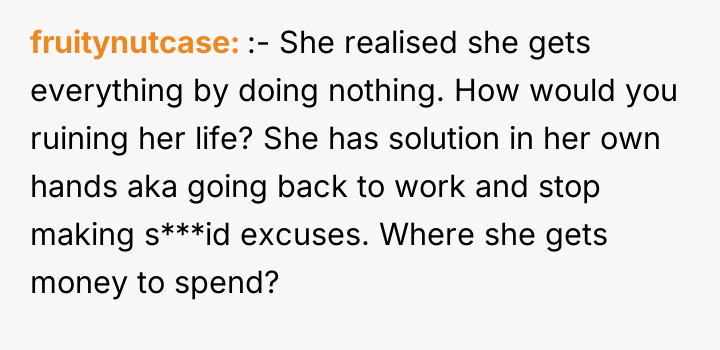
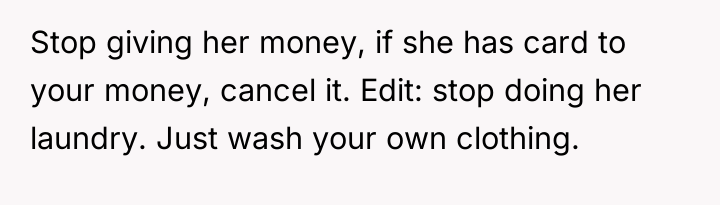
What started as a simple post quickly turned into a wildfire of opinions, with users chiming in from all sides.


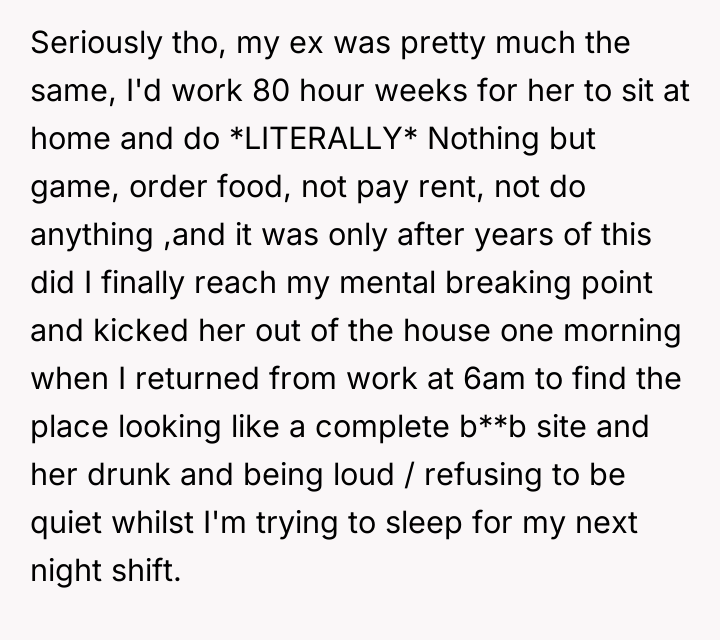
The original poster (OP) is experiencing extreme exhaustion due to carrying the entire financial and domestic load of the relationship while his girlfriend prioritizes leisure and avoids responsibility, using societal events as justification. The core conflict lies between the OP's need for partnership, stability, and rest, and the girlfriend's current pattern of dependency and financial irresponsibility.
Given the OP's exhaustion and the girlfriend's lack of financial means, how can the OP establish firm boundaries and enforce necessary changes in their living situation without causing the girlfriend immediate financial ruin or homelessness?
Trending This Week

WIBTA to insist my neighbor keep a yard schedule?
For background I have a severely reactive rescue dog. She's terrified of other dogs and freaks out majorly when she sees them or hears them. My partner and I have been working with our vet and a behavioral trainer and we've made some progress, but my dog is still not truly comfortable anywhere but her own yard. A new lady just moved in next door, and she has two big dogs. They seem like nice dogs, they are quiet and she works with them a lot. The problem is that she works from home full time, and her dogs are always outside. She doesn't leave them there for hours or anything, but I never know when she's going to let them out or for how long. She also spends a lot of time out there with them after work and on weekends. To be fair to her, she trains them and she doesn't let them run up on the fence, and if they do bark, she makes them go inside. They're still out on the other side of the fence though and my dog is now scared and reacting in her own backyard. When my dog starts carrying on, she is the one who has to go inside. She already can't enjoy walks and now she can't even enjoy being outside. I asked my neighbor if she'd consider a schedule for the dogs so that my dog can enjoy her yard too without the neighbor's dogs freaking her out on the other side of the fence. She was polite about it but said no, she bought the house with the yard for her dogs, and they use it. She said she'd be glad to tell me when she's leaving with them for a period of hours, but otherwise she's not going to change what she's doing day to day. So nothing changed and her dogs get plenty of outdoor time and mine gets none except for the stray times when she takes one of her dogs to a training class or takes both of them for a hike. I'm really upset and want to insist that we adopt a schedule so that my dog can have some outside time too. My dog does not get the same opportunity as her dogs, not even close. Her dogs have free access five days a week, weeknights, and weekends. My dog only gets outside time now when she says she is leaving for a class or a hike. If I let my dog out to sun herself at 10:30 on a Tuesday, sure enough, it won't be five minutes before she's letting her dogs out and then my dog freaks out and has to come in. She is not getting anywhere close to what they are getting. The fence is a privacy fence. My dog freaks out when she can hear and smell the other dogs as well as see them. She can't see these dogs but she knows they're there.

AITA for not wanting to "adjust" to my(28F) boyfriend's(26M) parents living with us for months at a time?
My boyfriend and I have been living together for three years in Australia. A few months ago, his parents arrived from India to live with us. Although I was excited to make them feel comfortable, their demands soon made me feel uneasy in my own home. They were uncomfortable with us sleeping in the same room, resulting in my boyfriend sleeping in the living room for two months. The mother took over the kitchen and excluded me from grocery shopping, and they did not acknowledge me as his girlfriend in front of friends or help with cleaning. They also rearranged furniture against our requests, and his father expressed concern that I was not helping in the kitchen, which was untrue. Furthermore, they credited my boyfriend for things he did not do and criticized my clothing, claiming it violated their family values. My primary issue is that my boyfriend did not acknowledge these problems or stand up for me. He dismissed my concerns, saying his parents were guests and his father was simply traditional. After they left, I moved to another city for a job, and our long-distance relationship has been great. However, he recently informed me that his parents are visiting again for two months, having booked the tickets without consulting me. He expects me to accept frequent, long visits as a condition of moving back in together. I feel my privacy and personal space are being disregarded, and I want him to consider my needs and set boundaries.

AITAH for not telling my housemate I’m moving out and taking everything with me?
I have lived with two of my friends in a rented house share for ten months. Around three months into our tenancy, a girl we did not know moved in to fill the final room. While I was initially excited to have another female housemate, our first interaction was tense; instead of greeting me, she immediately asked about our cleaning plans. Despite explaining our weekly routine, she quickly began using our kitchen items and leaving them dirty. When one of my friends gently addressed this, she reacted by shouting at me for fifteen minutes, accusing me of trying to look good in front of the male roommates. Over the next seven months, her behavior deteriorated further. She monopolized the clothes drying racks, damaged our communal chopping boards, and left her hair all over the floors. Additionally, she filled the entire freezer, left appliances dirty, neglected bathroom hygiene, and took my personal hygiene products without permission. Whenever we tried to address these grievances, her anger was directed solely at me. Recently, a new job opportunity allowed my two friends and me to find a three-bedroom flat together. We are moving out next week. Since we purchased about ninety percent of the communal items in the house—including the toaster, microwave, kettle, and vacuum—we plan to take them with us. Because our communication has completely broken down, I have decided not to inform her of our departure, leaving her to find out when she notices the viewings or when the moving van arrives.