AITA for refusing to let my mom move into my new house
For five relentless years, he poured every ounce of energy into building a future where stability wasn’t just a dream but a reality. Balancing full-time work, side gigs, and full-time school, he sacrificed comfort and time, all for the moment his offer on a home was finally accepted—a testament to his grit and unwavering hope.
Yet, beneath this hard-earned triumph lies the fragile thread of a strained relationship with his mother, whose financial struggles and dependence have complicated their fragile truce. What started as a temporary solution to help her has become a daily battle, testing the limits of his resilience and the true cost of sacrifice.


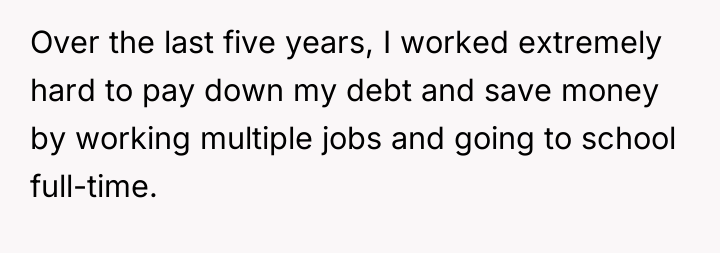
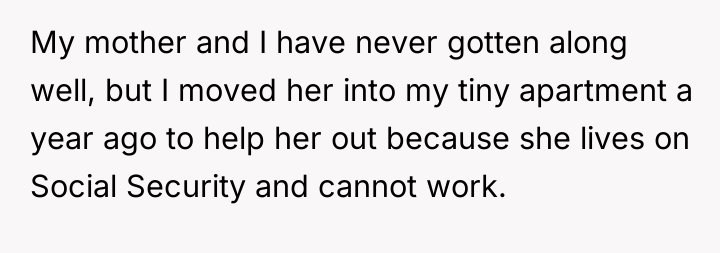
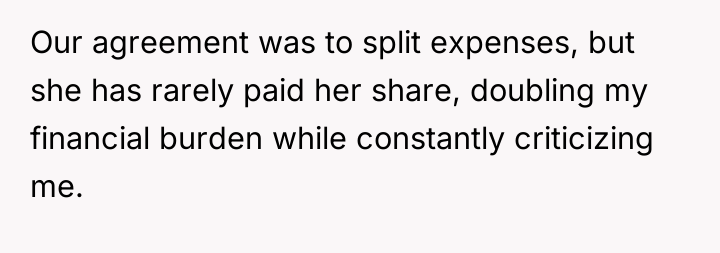
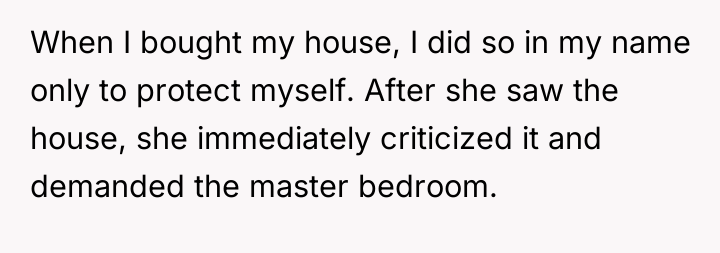

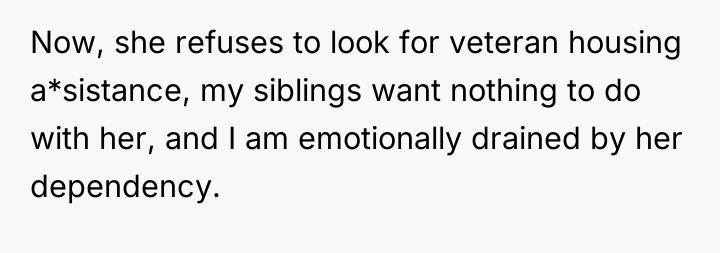
According to Dr. Henry Cloud, a clinical psychologist and co-author of the book Boundaries, people who have boundary issues routinely take on tasks that are not theirs to do, and they often suffer from burnout and resentment as a result. In this situation, the son has spent a year enabling his mother's financial irresponsibility by covering her unpaid share of the living expenses, which has doubled his financial burden. His mother's chronic poor financial habits, combined with her critical attitude and sense of entitlement—such as demanding the master bedroom in a house she did not contribute toward—demonstrate a severe lack of personal boundaries and respect for her son's autonomy.
The dynamic between the son and his mother is a classic example of parentification and codependency, where the child assumes the caretaking role for an irresponsible parent. By refusing to explore housing assistance programs available to her as a veteran, the mother exhibits learned helplessness, relying entirely on her son to solve her problems. The son’s decision to exclude her from the home purchase process and eventually revoke her invitation to move in represents a desperate but necessary attempt to establish a boundary and protect his financial future from her creditors and perpetual debt.
Ethically and psychologically, the son's decision to rescind the offer for his mother to live with him is appropriate and necessary for his own mental and financial well-being. To handle this transition effectively, he should firmly refuse to back down on his boundary while providing her with a list of veteran housing resources and social services. He must allow her to face the consequences of her financial choices, facilitating her transition to independent government-assisted living rather than continuing a cycle of resentment-fueled enablement.
HERE’S HOW REDDIT BLEW UP AFTER HEARING THIS – PEOPLE COULDN’T BELIEVE IT.:
Users didn’t stay quiet — they showed up in full force, mixing support with sharp criticism. From calling out bad behavior to offering real talk, the comments lit up fast.
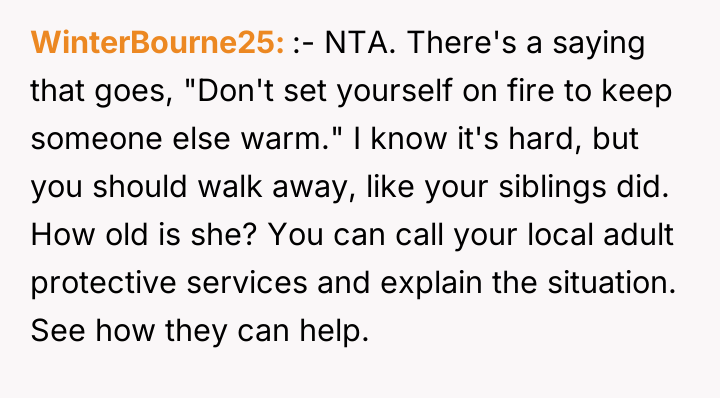
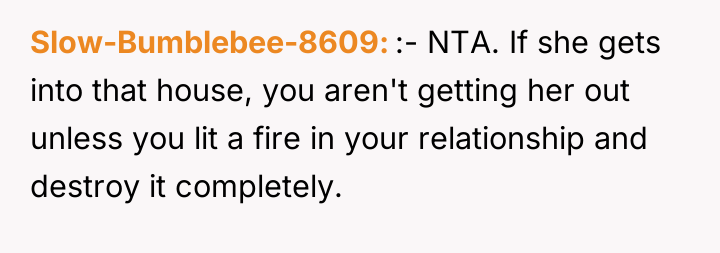
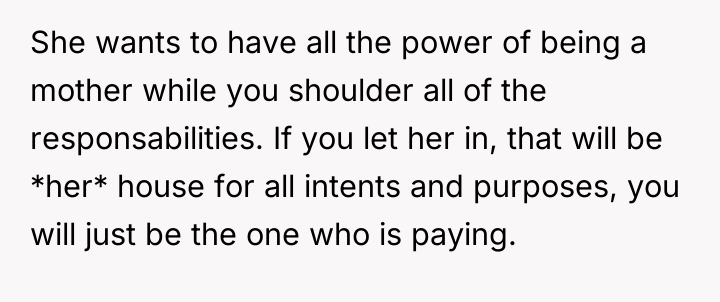
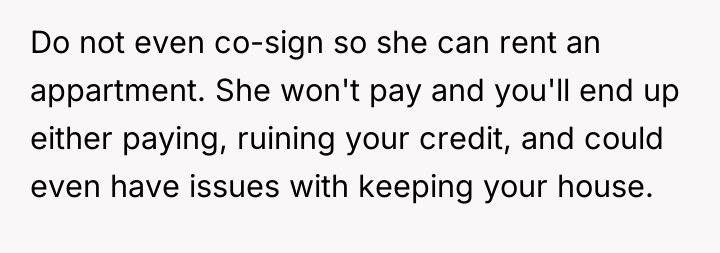
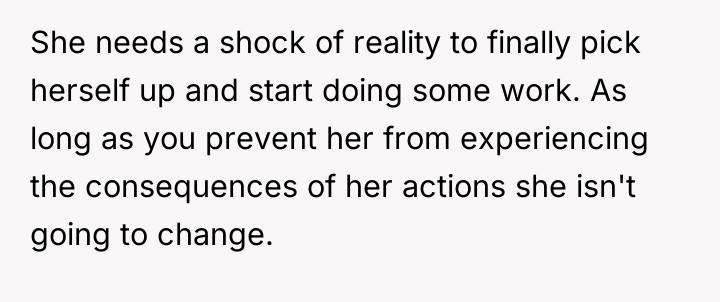

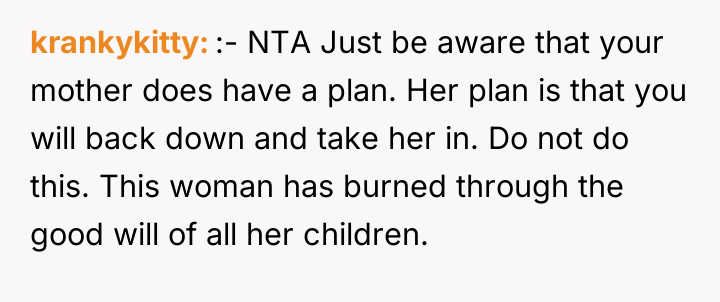

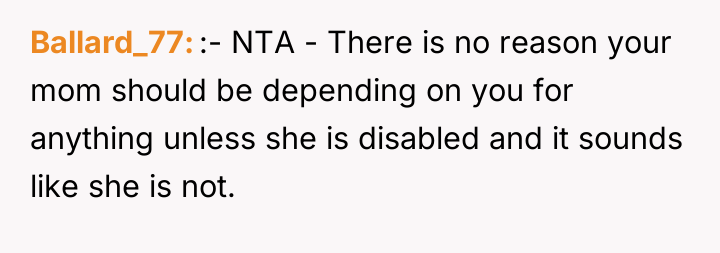



The homeowner is caught in a deeply painful position, torn between the exhausting financial and emotional drain of supporting his mother and the societal expectation to care for an aging parent. Despite his efforts to help, her lack of financial responsibility and constant criticism have pushed him to his absolute limit, forcing a clash between his need for personal boundaries and her survival.
Should a child be obligated to sacrifice their own financial security and mental well-being to support a parent who refuses to help themselves, or is it entirely justified to sever ties and prioritize one's own hard-earned peace of mind?
Trending This Week

AITA for telling my sister that her husband is having an affair?
I am seventeen years old, and my twenty-five-year-old sister is married to a thirty-eight-year-old man named James. Recently, while having lunch at a restaurant with a friend, I saw James with another woman. They appeared to be on an intimate date. My friend advised me to record them instead of confronting them immediately, so we gathered video proof. I went straight to my sister's house and showed her the footage. Instead of being sad, she became furious with me, accusing me of trying to ruin her marriage out of jealousy, and she kicked me out and blocked me. The next day, my sister arrived at our parents' house with her bags, having decided to leave James. She apologized to me, explaining that she already had suspicions but had reacted badly because she had fought hard against our family to marry him. Our father had previously warned her about James's manipulative nature and the age gap. My sister and I reconciled, and she is now proceeding with a divorce.

AITA for telling my sister she has more than enough children?
My sister already has six children with her husband, which is far more than they can comfortably provide for given their financial troubles. It is also more than both of them can handle, resulting in my fifteen-year-old niece being treated as an unpaid babysitter who is constantly expected to help with her younger siblings. Recently, my sister experienced a miscarriage during the early stages of her seventh pregnancy. While talking to her about this painful experience, I remarked that at least she already has six other children and suggested that perhaps that is enough. My sister was highly offended, calling me insensitive and stating that her family choices do not concern me. However, they do affect me, as I have loaned her and her husband money on multiple occasions to help support their household.

AITAH For reclaiming my pregnancy snacks and not telling people about the pregnancy?
I am currently 14 weeks pregnant and have not told many people at work aside from HR, my direct supervisor, and a few close colleagues. It is not widely known that I am pregnant and I have been wearing baggy clothes as I wanted to wait a good amount of time before announcing it. My issue is that I now have limited foods I can eat and keep snacks at my desk so I can nibble throughout the day. I had a bowl of mixed fruit snacks (Welches and Albanese) and recently found out that I cannot eat the Welches because my blood sugar reacts more to them. I had yet to sort out the bowl and left it out for two days on the back of my desk. A coworker walked behind me, assumed I was in a meeting, and started taking them. I felt weird and did not say anything in the moment. I waited until after she left to sort out the fruit snacks and decided to be nice and put out the bowl in a shared area with the Welches since I will not be able to eat them. A week later, a different coworker was complaining loudly by my desk that someone had sorted the fruit snacks and taken all the good ones, leading me to believe multiple people were taking my snacks without asking. I normally keep them in my cabinet but forgot to put them away and was gone the following day. Since I pay for them myself, I am wondering if I overreacted by taking away the fruit snacks I can eat, or if I should stop keeping snacks at my desk entirely.