
My Sister-In-Law Cheated and Had a Baby, Now She's Calling Me R***st for Laughing at the Truth
The original poster (OP), a 21-year-old male, recounts a highly sensitive family situation involving his older brother (32M) and his soon-to-be ex-sister-in-law (SIL, 27F), who is white. The OP, who is Korean American and values his deep family ancestry, returned home from college when his brother announced his wife was in labor.
Upon arriving at the hospital, the OP entered the room with a lighthearted attitude only to find a baby that did not resemble his brother or the SIL, noting the baby's darker skin and distinct features. After realizing the implications of what he saw and later confirming through a DNA test that the baby was not his brother's, the OP found himself caught in the resulting fallout as his brother decided on divorce, leaving the OP questioning his actions when the SIL accused him of racism.












As family therapist and author Dr. Terri Givens states, 'In high-conflict family situations, managing your own emotional response is crucial, but defending your intent often minimizes the real impact your actions have on others.'
This situation involves complex layers of betrayal, familial duty, and the introduction of race into a deeply personal crisis. The OP's laughter, though he clarifies it was directed at the shock of the paternity issue, was a high-visibility, unfiltered emotional response in a highly charged environment. For the SIL, whose actions have already caused immense pain, the OP’s laughter immediately translated into an attack, especially given the racial difference of the child, which introduces an element of public judgment onto her secret. The brother’s advice to apologize stems from a desire to quickly neutralize conflict and protect the immediate family unit from further drama, prioritizing relational peace over validating the OP's personal feelings of justification.
From an objective standpoint, the OP's actions were inappropriate in that specific moment because the immediate impact outweighed the intended meaning. In future high-stakes emotional situations, the OP should focus on non-verbal deference—excusing oneself immediately rather than verbalizing shock—when faced with sensitive revelations. While he is not obligated to apologize for the underlying truth of the paternity test, a brief, de-escalating acknowledgment of the SIL's distress (e.g., 'I am sorry for my reaction, this is overwhelming') could satisfy the need for relational repair without requiring him to concede that he acted with racist intent.
THIS STORY SHOOK THE INTERNET – AND REDDITORS DIDN’T HOLD BACK.:
Users didn’t stay quiet — they showed up in full force, mixing support with sharp criticism. From calling out bad behavior to offering real talk, the comments lit up fast.









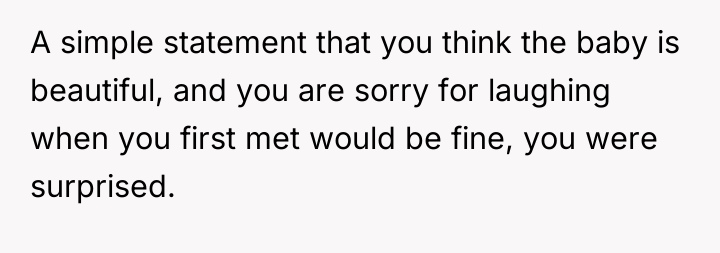



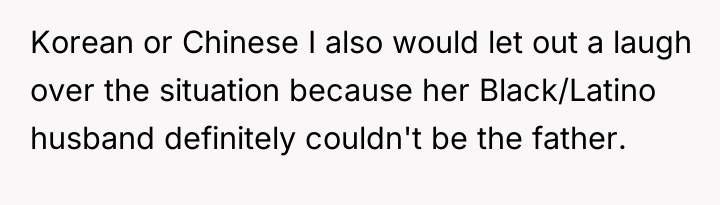











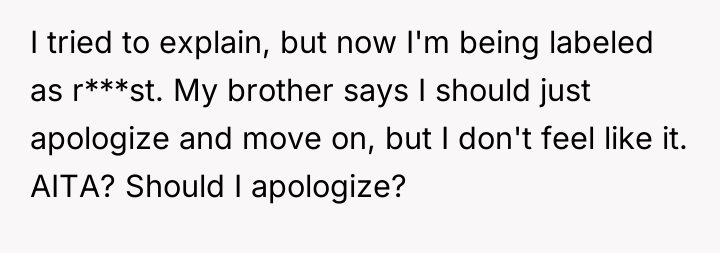
The OP is currently facing a dilemma regarding whether he should apologize to his soon-to-be ex-SIL, who is trying to reconcile with his brother after admitting to infidelity that resulted in a child that is not biologically his. While the OP's initial reaction was shock at the situation rather than derision toward the infant, his laughter led to him being labeled as racist by the SIL, putting him at odds with his brother's request for reconciliation.
The core question remains whether the OP owes the SIL an apology for his reaction, despite his intentions being focused on the infidelity revelation rather than the child's appearance, or if he is justified in refusing due to the circumstances and the SIL's subsequent actions. Readers must weigh the impact of the OP's visible reaction against the context of the underlying betrayal.