
AITA for leaving my husband at the airport after he tried to make me carry his luggage?
After four long weeks apart, the moment of reunion at the airport should have been filled with warmth and relief. Instead, a sharp tension cut through the air as exhaustion clashed with expectation, revealing cracks in their bond that no time or distance had healed. The weight of his bags became a symbol not just of physical burden, but of emotional strain threatening to overwhelm them both.
In her delicate state, carrying the weight of new life within her, she faced a harsh and unyielding reality. His demands and dismissive tone pierced through her resolve, igniting a silent storm of hurt and frustration. This was no longer just about luggage—it was about respect, understanding, and the fragile threads holding their relationship together.










Subscribe to Our Newsletter
As renowned psychologist Dr. John Gottman explains, 'The master ratio for stable, happy relationships seems to be 5:1. For every single interaction that is negative, there must be five that are positive.' This situation highlights a severe imbalance in positive versus negative interactions, where a moment requiring support immediately turned into a conflict centered on unacknowledged physical needs.
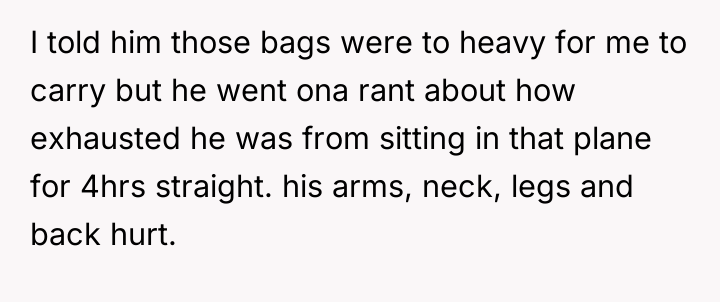
The husband's behavior—demanding service, dismissing his wife's pregnancy as irrelevant ("still in good shape"), and escalating his tone when refused—demonstrates a lack of empathy and a failure to recognize relational boundaries. His physical discomfort from a four-hour flight does not equate to the physical strain and risks associated with carrying heavy luggage while 12 weeks pregnant. By insisting his tiredness superseded her physical limitations and calling her annoying, he invalidated her reality. The OP’s reaction, while emotionally charged, was a direct consequence of feeling utterly dismissed and treated like an unpaid porter rather than a partner. Leaving the luggage was a clear, albeit dramatic, attempt to enforce a boundary that her verbal communication failed to establish.
The OP's action was an understandable reaction to an invalidating demand, but it escalated the conflict significantly. For future situations, the OP should establish clear, pre-agreed expectations about physical assistance during pregnancy, especially after travel. If a partner insists on unreasonable demands, a more constructive approach than abandonment might be to clearly state, "I cannot lift that safely; I am calling a porter/waiting here until you arrange transport for the bags," ensuring physical safety is prioritized without immediately resorting to leaving the partner stranded.
THE COMMENTS SECTION WENT WILD – REDDIT HAD *A LOT* TO SAY ABOUT THIS ONE.:
It didn’t take long before the comment section turned into a battleground of strong opinions and even stronger emotions.






















The original poster (OP) felt deeply disrespected and humiliated after her husband demanded she carry his heavy luggage immediately upon his return from a long trip, despite her being pregnant. The central conflict arose from the husband prioritizing his minor discomfort after a flight over acknowledging and accommodating his wife's pregnant physical limitations and expectations for a supportive reunion.
Was the OP's decision to leave the luggage and drive away an overreaction to a demand that disregarded her physical state, or was the husband justified in expecting assistance from his spouse after a long journey, making the OP's action unsupportive?