AITA for helping my sister walk when everyone thinks she is exaggerating?
A young girl’s silent suffering unfolds quietly within the walls of her home, her fragile body wracked by pain that shifts and swells like an unseen storm. Each step is a battle, each movement a test of endurance, as her older sister holds her up, a steadfast anchor in a sea of agony and uncertainty. The helplessness hangs thick in the air, a desperate search for answers where medicine finds none.
Behind closed doors, the family wrestles with fear and confusion, caught between hope and despair as the girl’s torment persists without explanation. The doctor’s reassurances ring hollow against the reality of her pain, and the nights see her restless, twisting in sleep as if fleeing invisible torment. This is more than a physical ailment—it is a quiet crisis that threatens to unravel their world.







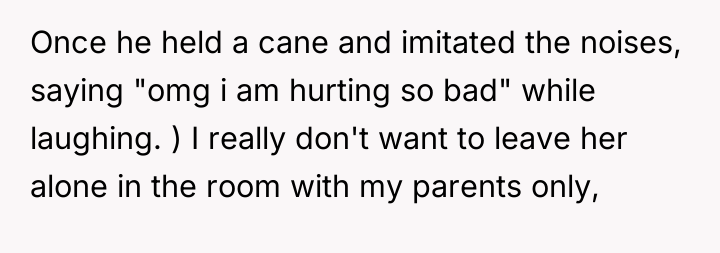
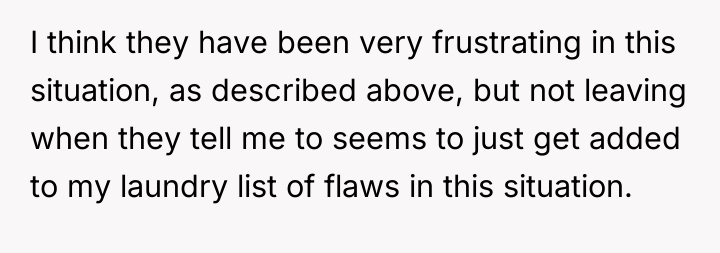

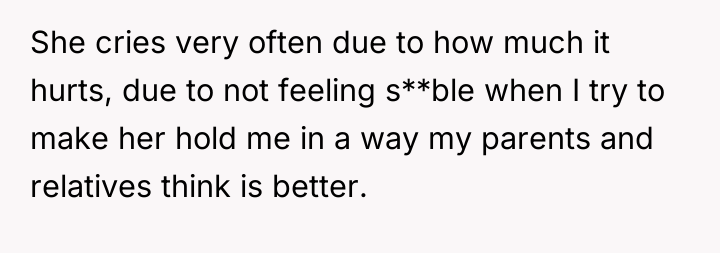
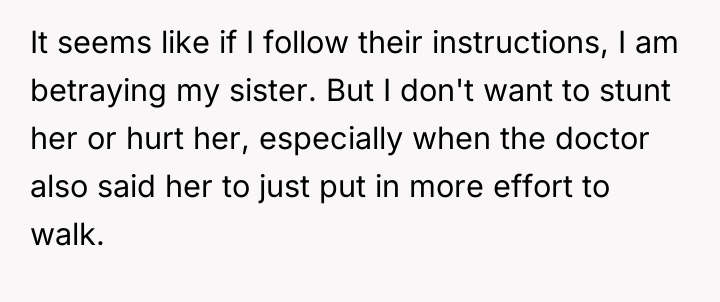

As renowned researcher Dr. Brené Brown explains, “Boundaries are the distance at which I can love you and me simultaneously.” This situation highlights a severe lack of healthy boundaries within the family structure, not just concerning the 12-year-old's health, but also regarding the OP's role in caregiving and the father's behavior.
The core conflict is rooted in validating subjective experience versus demanding objective proof. The sister reports pain, which the OP witnesses, yet the medical report offers no definitive diagnosis, leading the family to default to skepticism and punitive measures, exemplified by the father's mocking behavior. This dynamic creates an environment of gaslighting for the sister and intense emotional labor for the OP. When the sister is actively moving in her sleep, it strongly suggests that her physical presentation while awake might be influenced by genuine distress, even if the underlying cause is complex (e.g., conversion disorder, psychosomatic illness, or fluctuating acute pain not captured by blood tests). The OP's attempt to provide physical support, while compassionate, inadvertently reinforces the family's narrative that the sister is incapable.
The OP's actions are appropriate in terms of expressing empathy and loyalty to their sister, but counterproductive in terms of managing the family dynamic. A constructive recommendation would be for the OP to shift from being the sole physical support mechanism to being the primary emotional advocate. This involves clearly communicating to the parents that mocking pain, regardless of its origin, is damaging, and perhaps suggesting a follow-up with a specialist who addresses the mind-body connection (like a pediatric neurologist or a child psychologist) rather than continuing to push for 'more effort' based on the current physician's generalized advice.
THE COMMENTS SECTION WENT WILD – REDDIT HAD *A LOT* TO SAY ABOUT THIS ONE.:
The thread exploded with reactions. Whether agreeing or disagreeing, everyone had something to say — and they said it loud.



The original poster (OP) is caught between intense loyalty to their younger sister, who reports severe, fluctuating pain, and the persistent belief held by the rest of the family that the sister is exaggerating or faking her symptoms. The OP's desire to support the sister directly conflicts with the family's expectation that the OP should enforce more independence, leading to significant emotional distress and a feeling of betrayal when trying to comply with parental directives.
Given the conflicting evidence—a doctor's inconclusive findings versus the sister's clear suffering and the family's punitive reaction—is the OP's primary duty to provide comfort and support based on the sister's subjective experience, or should the OP enforce the family's conclusion that the sister needs to exert more independent effort to overcome potential attention-seeking behavior?
Trending This Week

AITA for telling my sister she has more than enough children?
My sister already has six children with her husband, which is far more than they can comfortably provide for given their financial troubles. It is also more than both of them can handle, resulting in my fifteen-year-old niece being treated as an unpaid babysitter who is constantly expected to help with her younger siblings. Recently, my sister experienced a miscarriage during the early stages of her seventh pregnancy. While talking to her about this painful experience, I remarked that at least she already has six other children and suggested that perhaps that is enough. My sister was highly offended, calling me insensitive and stating that her family choices do not concern me. However, they do affect me, as I have loaned her and her husband money on multiple occasions to help support their household.

AITA for not wanting to "adjust" to my(28F) boyfriend's(26M) parents living with us for months at a time?
My boyfriend and I have been living together for three years in Australia. A few months ago, his parents arrived from India to live with us. Although I was excited to make them feel comfortable, their demands soon made me feel uneasy in my own home. They were uncomfortable with us sleeping in the same room, resulting in my boyfriend sleeping in the living room for two months. The mother took over the kitchen and excluded me from grocery shopping, and they did not acknowledge me as his girlfriend in front of friends or help with cleaning. They also rearranged furniture against our requests, and his father expressed concern that I was not helping in the kitchen, which was untrue. Furthermore, they credited my boyfriend for things he did not do and criticized my clothing, claiming it violated their family values. My primary issue is that my boyfriend did not acknowledge these problems or stand up for me. He dismissed my concerns, saying his parents were guests and his father was simply traditional. After they left, I moved to another city for a job, and our long-distance relationship has been great. However, he recently informed me that his parents are visiting again for two months, having booked the tickets without consulting me. He expects me to accept frequent, long visits as a condition of moving back in together. I feel my privacy and personal space are being disregarded, and I want him to consider my needs and set boundaries.

AITAH for getting a dna test to see if i share the same dna as both my parents even though i was demanded specifically by my mom not to do so, since i was a child?
I have always suspected that I might not be biologically related to my parents. Growing up, my mother treated me and my younger brother very differently. I was disciplined more harshly, grounded for longer periods, and subjected to invasive phone searches, while my brother faced few consequences even when he got his girlfriend pregnant at sixteen. My father was mostly passive and uninvolved in my upbringing. Due to the toxic environment, I eventually moved 1,000 miles away with my spouse to find peace. My suspicions are fueled by physical and legal anomalies. I do not share my parents' physical features, such as their freckles or dark brown eyes, and I am the only person in both my immediate and extended family with a completely different last name. Whenever I questioned my mother about my last name, she became defensive and refused to explain. Recently, during a family visit, a card game prompted me to admit to getting a DNA test. My mother reacted with immediate anger and hostility, which caused me to panic and lie that I was joking. Despite promising my mother during my childhood that I would never take a DNA test, my curiosity led me to purchase a kit. My mother's oldest sister recently found a long-lost sister through a DNA test, yet my mother remains strictly opposed to me doing the same. I have sent my kit in and expect the results soon, but I feel immense guilt, as if searching for the truth is a betrayal that could ruin my family relationships.