
AITA for calling my wife out on giving "joint" birthday present without me there?
A father wrestles with a quiet ache on his son’s fifth birthday, absent from the morning’s joy due to work commitments that keep him away when his children wake. The little moments he misses weigh heavily on him, especially when he learns his wife has already given their son a birthday present, one meant to be shared but instead given alone, stirring feelings of exclusion and hurt.
In the tender space between love and misunderstanding, he confronts the pain of missing out on his child’s excitement firsthand. What should be a celebration of togetherness becomes a test of trust and intention, as he questions whether the early gift was a thoughtful kindness or a selfish act that steals from their shared joy.






Subscribe to Our Newsletter
As renowned researcher Dr. Brené Brown explains, “Boundaries are the distance at which I can love you and me simultaneously.”
This situation highlights a misalignment in how the OP and his wife define shared responsibility and shared experience within their marriage, particularly concerning significant family milestones. The OP views the act of presenting a joint gift as a relational event that requires both parents present, likely connecting the timing to his emotional commitment despite his physical absence due to work. He interprets the wife's unilateral action as prioritizing her own immediate gratification (experiencing the joy alone) over honoring their partnership. Conversely, the wife appears to be acting from a place of protecting the child's immediate emotional needs, believing that waiting several days for the primary celebration (Saturday's party) would cause unnecessary distress for a five-year-old. Her action, while bypassing the OP, may stem from a functional desire to manage the child's excitement effectively.
The core issue here is not the gift itself, but the differing interpretations of 'fairness'—fairness to the child versus fairness to the partnership structure. The OP's reaction, while understandable emotionally, escalated the situation by immediately labeling his wife's motive as 'selfishness.' A more constructive approach would have involved establishing a pre-agreed protocol for milestones occurring when one parent is absent, rather than confronting the choice after the fact. Moving forward, the couple needs to clearly define what joint acts require both partners present and which can be delegated or managed individually to avoid these clashes over perceived exclusion.
HERE’S HOW REDDIT BLEW UP AFTER HEARING THIS – PEOPLE COULDN’T BELIEVE IT.:
The internet jumped in fast, delivering everything from kind advice to cold truth. It’s a mix of empathy, outrage, and no-nonsense takes.








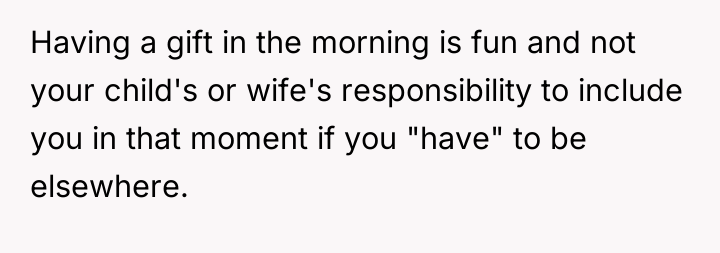









The original poster (OP) is clearly feeling hurt and excluded because his wife presented their son's birthday gift from both parents on the morning of his fifth birthday, while the OP was away for work. The central conflict lies between the OP's belief that the gift presentation should have been a shared experience later in the day, and the wife's insistence that making the child wait until the planned weekend party is unfair to him.
Was the wife justified in presenting the gift from both parents alone to avoid disappointing the young child, or did her action disrespect the OP's desire to share in that significant moment? Should the OP prioritize the immediate happiness of the child over maintaining a shared ritual for gift-giving?