My Ex-Husband Left Me for His Work Wife and Now He’s Begging for My Help
Their marriage, once filled with youthful hope and shared dreams, crumbled under the weight of betrayal and silence. Despite their divorce, the ties of parenthood keep them intertwined, forcing her to endure his constant complaints and emotional dumping, a painful reminder of the love that once was but is now irreparably broken.
She watched helplessly as Kevin’s affections drifted away, replaced by a toxic connection with his "work wife," a betrayal that shattered the foundation of their relationship. The discovery of his explicit messages was a cruel confirmation of her worst fears, turning years of commitment into nothing more than painful memories of what could have been.










As renowned family therapist and researcher Dr. Terry Real explains, “Boundaries are not about controlling the other person; they are about defining what you will or will not accept.” This situation clearly illustrates the need for strong personal boundaries following a significant betrayal and divorce. The OP's ex-husband, Kevin, is engaging in inappropriate behavior by offloading the emotional distress from his current relationship onto his former spouse. This dynamic is often seen when one partner has historically relied on the other for emotional regulation, a pattern that did not cease upon divorce.
Kevin’s actions—seeking therapy from his ex-wife immediately after issues arose with his new partner—suggest a lack of healthy coping mechanisms and an inappropriate expectation of continued accessibility. The OP correctly identified that this is not her responsibility, especially considering Kevin’s past actions (the work wife affair) that directly led to the dissolution of their marriage. Her response, "stop telling me your business," is a direct, albeit perhaps belated, establishment of a necessary boundary.
The OP’s assertion that she does not care about the details of his current relationship is appropriate for maintaining her mental health. A constructive recommendation for future interactions would be to keep all communication strictly limited to logistics regarding the children. If Kevin attempts to steer conversations toward his personal life, the OP should respond once with a firm, pre-rehearsed phrase, such as, "I only discuss matters related to the children," and then immediately cease engagement on that topic, perhaps even ending the communication thread if he persists.
AFTER THIS STORY DROPPED, REDDIT WENT INTO MELTDOWN MODE – CHECK OUT WHAT PEOPLE SAID.:
The community had thoughts — lots of them. From tough love to thoughtful advice, the comment section didn’t disappoint.






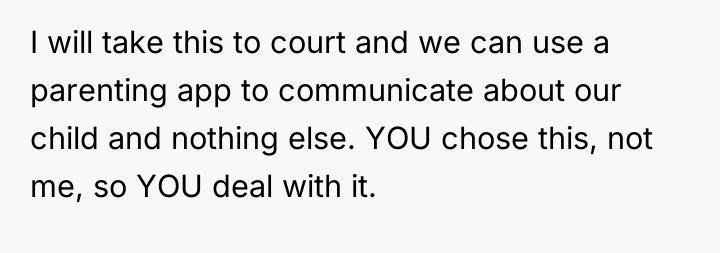







The original poster (OP) is attempting to maintain firm emotional distance from her ex-husband, Kevin, by refusing to engage with his personal relationship problems, especially given his past infidelity. The central conflict lies between the OP's need to protect her own peace and the ex-husband's expectation that she continue to serve as an emotional confidante or therapist, despite their separation and his new relationship.
Is the OP justified in completely shutting down communication regarding her ex-husband's current relationship crisis, or does their shared history and co-parenting relationship necessitate a minimal level of engagement or emotional support?
Trending This Week

AITA for canceling stepdaughter's birthday party?
My stepdaughter is turning 18 and lives mostly with her mother. My husband works a lot but is a very involved father. He asked me to plan her birthday party, and I agreed, spending several hundred dollars and many hours of my own time to make sure everything was perfect. The conflict began when the biological mother demanded my husband buy over five thousand dollars in jewelry and concert tickets for their daughter, which we could not afford. When my husband refused, the biological mother drove to our home, stood in our driveway, and began screaming and cursing at him. To defend my husband and our home, I went outside and told her to shut her mouth and that she had no right to speak to him that way. Although my stepdaughter was not present, her mother told her about the confrontation. Consequently, my stepdaughter uninvited me from the party I planned and funded, claiming she and her mother felt too uncomfortable to have me there. In response, I decided to cancel the reservations, catering, and decorations, choosing to redirect my money elsewhere.
AITA for not wanting to "adjust" to my(28F) boyfriend's(26M) parents living with us for months at a time?
My boyfriend and I have been living together for three years in Australia. A few months ago, his parents arrived from India to live with us. Although I was excited to make them feel comfortable, their demands soon made me feel uneasy in my own home. They were uncomfortable with us sleeping in the same room, resulting in my boyfriend sleeping in the living room for two months. The mother took over the kitchen and excluded me from grocery shopping, and they did not acknowledge me as his girlfriend in front of friends or help with cleaning. They also rearranged furniture against our requests, and his father expressed concern that I was not helping in the kitchen, which was untrue. Furthermore, they credited my boyfriend for things he did not do and criticized my clothing, claiming it violated their family values. My primary issue is that my boyfriend did not acknowledge these problems or stand up for me. He dismissed my concerns, saying his parents were guests and his father was simply traditional. After they left, I moved to another city for a job, and our long-distance relationship has been great. However, he recently informed me that his parents are visiting again for two months, having booked the tickets without consulting me. He expects me to accept frequent, long visits as a condition of moving back in together. I feel my privacy and personal space are being disregarded, and I want him to consider my needs and set boundaries.

AITA for telling my sister that her husband is having an affair?
I am seventeen years old, and my twenty-five-year-old sister is married to a thirty-eight-year-old man named James. Recently, while having lunch at a restaurant with a friend, I saw James with another woman. They appeared to be on an intimate date. My friend advised me to record them instead of confronting them immediately, so we gathered video proof. I went straight to my sister's house and showed her the footage. Instead of being sad, she became furious with me, accusing me of trying to ruin her marriage out of jealousy, and she kicked me out and blocked me. The next day, my sister arrived at our parents' house with her bags, having decided to leave James. She apologized to me, explaining that she already had suspicions but had reacted badly because she had fought hard against our family to marry him. Our father had previously warned her about James's manipulative nature and the age gap. My sister and I reconciled, and she is now proceeding with a divorce.