AITAH for bringing a salad that I know one of my coworkers will hate to the monthly office potluck?
She feels the weight of expectation pressing down on her shoulders, a silent demand wrapped in passive aggression. What once was a simple gesture of camaraderie has morphed into a source of stress and resentment, as Janice’s subtle barbs chip away at her goodwill, turning a monthly potluck into a battlefield of unspoken tensions.
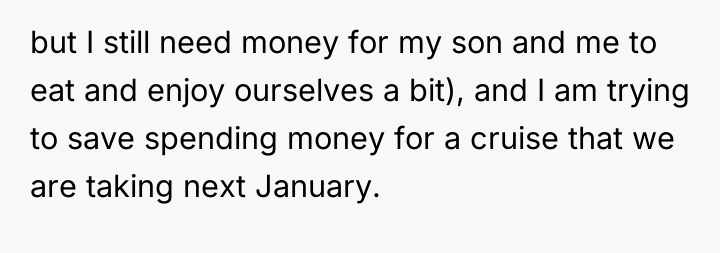
Caught between professional obligation and personal overwhelm, she struggles to balance the relentless demands of work, weddings, and family life. The looming salad bar theme, with its expensive and elaborate ingredients, becomes a symbol of the invisible burdens she’s forced to carry—reminding her that sometimes, kindness is mistaken for weakness.

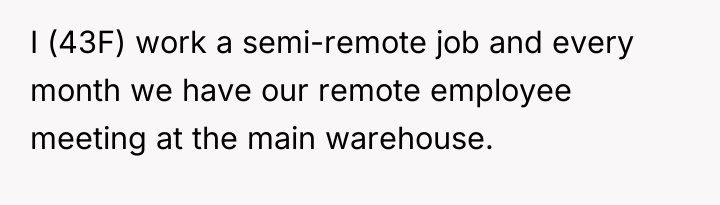


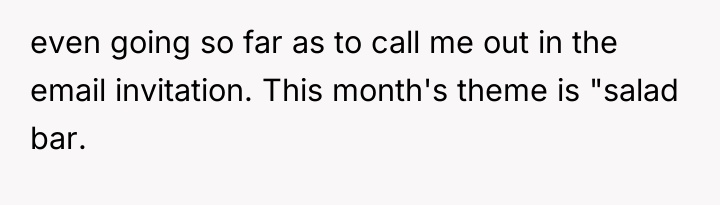


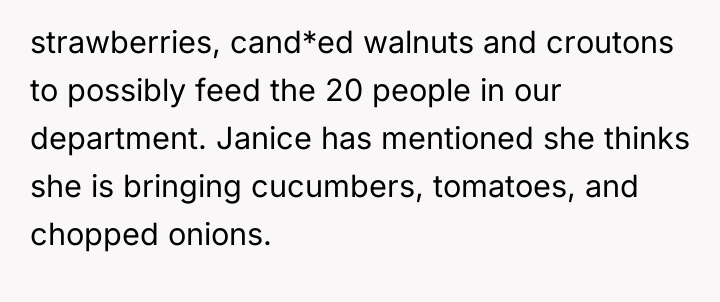
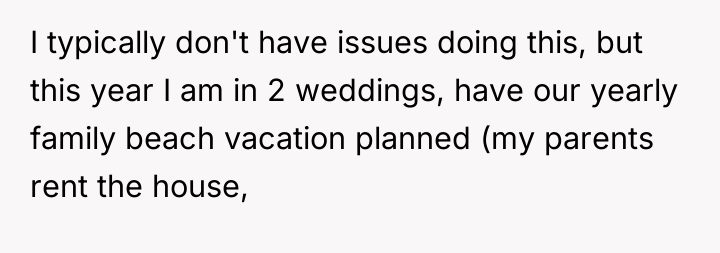
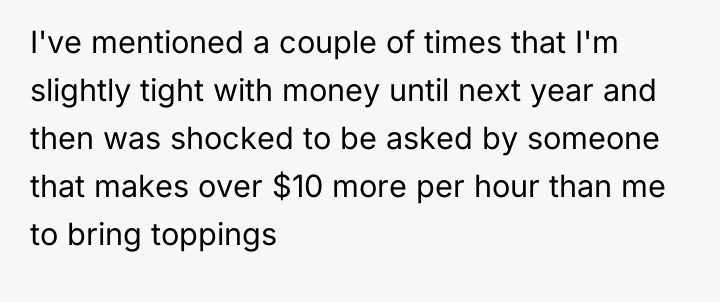






As renowned researcher Dr. Brené Brown explains, “Boundaries are the distance at which I can love you and me simultaneously.” In this scenario, Janice consistently violates professional and social boundaries by issuing specific, costly demands disguised as potluck suggestions, failing to respect the OP's stated financial limitations.
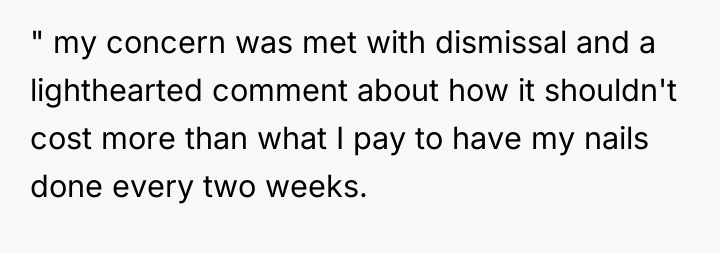
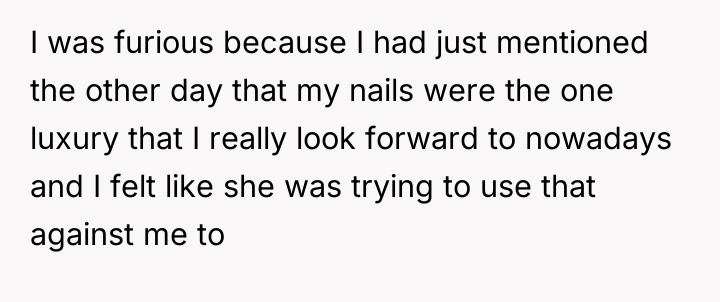
The OP's motivation to switch to a dish Janice dislikes appears to stem from a need to reclaim personal agency after feeling manipulated and dismissed, especially when Janice belittled the OP's stated need for financial prudence by comparing it to the cost of manicures. This shift from compliance to passive-aggressive resistance—bringing a dish specifically disliked by the perceived antagonist—is a common, albeit emotionally charged, response to perceived injustice and a breakdown in healthy communication. The OP's action serves as a non-verbal assertion of boundaries, prioritizing their own financial needs and emotional relief over smooth social conformity. However, this approach often escalates workplace tension rather than resolving the core issue of entitlement.
While the OP's decision to protect their leftover food and assert their independence is understandable given the context, intentionally choosing a dish the coworker dislikes is not an appropriate long-term strategy for managing professional relationships. A more constructive path would involve setting a firm, clear boundary about future participation: "Janice, moving forward, I can only contribute simple items like napkins or desserts that cost under $10 for potlucks, given my current budget." This direct, non-emotional statement addresses the expectation without resorting to retaliatory actions.
THIS STORY SHOOK THE INTERNET – AND REDDITORS DIDN’T HOLD BACK.:
Users didn’t stay quiet — they showed up in full force, mixing support with sharp criticism. From calling out bad behavior to offering real talk, the comments lit up fast.















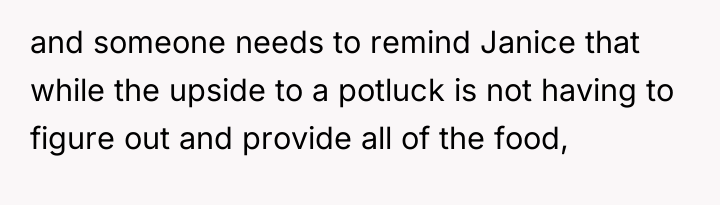

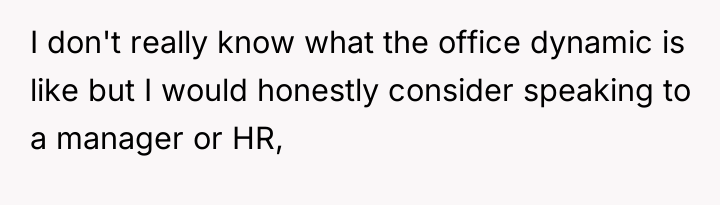

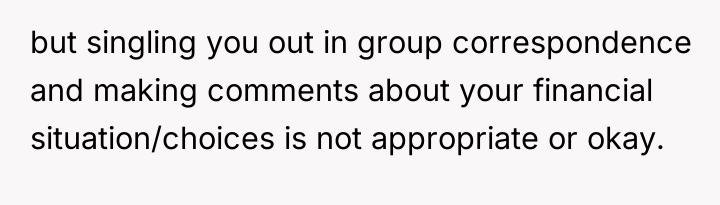


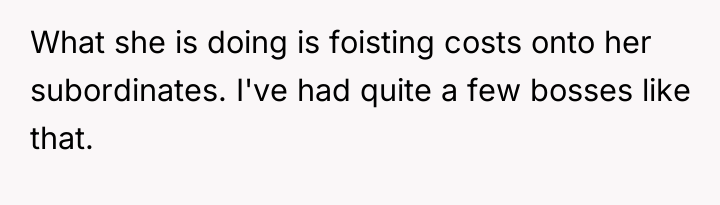

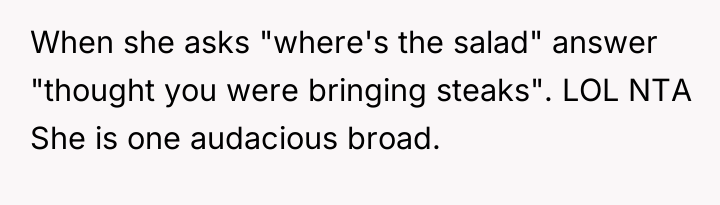

The original poster (OP) feels pressured and resentful because a coworker, Janice, consistently uses social obligations to demand expensive contributions to office potlucks, ignoring the OP's stated financial constraints. The central conflict lies in the OP's need to assert financial boundaries against Janice's controlling and dismissive behavior regarding shared event contributions.
Is the OP justified in retaliating by intentionally bringing a dish they know the pressuring coworker dislikes, or is this action counterproductive? Should the OP continue this passive-aggressive tactic until the coworker stops making demands, or is direct communication about future potluck participation the better approach?
Trending This Week

AITA for staying anonymous after reporting my sister and her husband to CPS?
My sister met her husband when she was pregnant with another man's child. She never told anyone in the family who the father is, and she never told the father about the child either. Her husband refused to include my nephew in the wedding or treat him as his own. Since they had their own children, his bad treatment of my nephew has become worse. He refuses to watch my nephew, threatens to let him starve, and says he would not stop him from getting hurt. My sister ignores this and defends her husband. I reported this to Child Protective Services anonymously. They investigated but did not remove my nephew because there were no physical injuries. My sister is angry about the report and wants to find out who made it. Some of my family think it is cowardly to stay anonymous, but I worry that if my sister finds out it was me, I will never see my nephew again.

AITA for telling my sister she has more than enough children?
My sister already has six children with her husband, which is far more than they can comfortably provide for given their financial troubles. It is also more than both of them can handle, resulting in my fifteen-year-old niece being treated as an unpaid babysitter who is constantly expected to help with her younger siblings. Recently, my sister experienced a miscarriage during the early stages of her seventh pregnancy. While talking to her about this painful experience, I remarked that at least she already has six other children and suggested that perhaps that is enough. My sister was highly offended, calling me insensitive and stating that her family choices do not concern me. However, they do affect me, as I have loaned her and her husband money on multiple occasions to help support their household.

AITA for telling my brother that if my parents need money they can ask me for it themselves.
My parents did not think a girl needed an education, so they chose not to save any money for me growing up. They had no interest in my education or extracurricular activities. My mom's brother, Bryan, grew up in the UK and he had a different attitude. He would always check in on me and see how I was doing in school. He bought me my first graphing calculator. Because I wanted to impress him, I worked myself raw to graduate with honors. I was the salutatorian in my school and received a scholarship to my dream school. I did not even bother telling my parents. I graduated from high school and moved to the west coast. My parents tried to convince me to come home, but I was quite happy for the first time I could remember. I studied in a STEM field and was recruited before I graduated. My job pays me very well and I met my husband at work. My brother also attended university and is an engineer. He does well for himself, except that he is constantly giving our parents money. My brother talked to me recently about how we needed to support our parents in their old age. I said I had no problem contributing to them. However, they would have to ask me for help. I would not volunteer it or send it through him. If they wanted my money, they had to ask for it. He says that they won't because it would shame my father to ask a woman for money. I am okay with him feeling shame after the way he raised me. My brother says I am being unreasonable and it does not matter since my parents know where the money will be coming from. I think that my parents need to get over themselves.